
Educational scope: Educational arithmetic using fictional values. This tool calculates supplied numbers; it does not prescribe a fluid, medicine or rate or assess clinical competence. Do not enter patient identifiers. Free, with no account or email needed.
Written by Dr. Ezekiel Aluda Osolika, emergency physician (MBChB, FEBEM). Clinical content reviewed by the author on 24 October 2026; review covered the calculations and teaching diagrams. This is author review, not an independent second review. All values are fictional. Content version 2026-10-24-1. Spotted an error? Report a correction and name the calculation.
Calculate a practice example
Three calculations, each with the formula, the substituted numbers, the unrounded value and the rounded teaching result. Nothing you enter is saved or sent.
The interactive practice needs JavaScript. The formulas and worked examples below show every step.
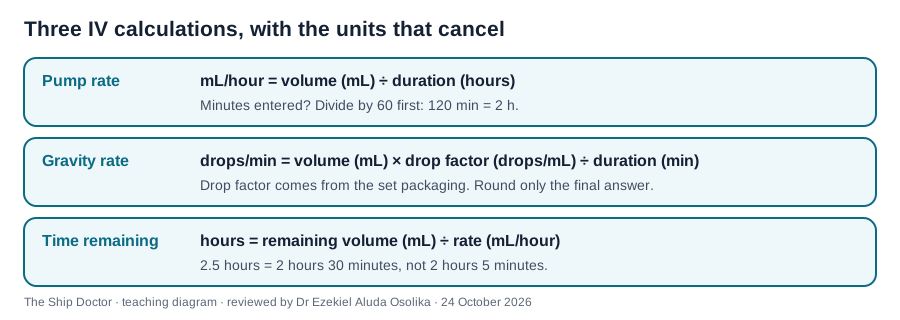
Pump rate (mL/hour)
Worked example: 1000 mL over 8 hours = 1000 ÷ 8 = 125 mL/hour.
Gravity rate (drops/minute)
Worked example: 500 mL over 240 minutes with a 20 drops/mL set = 500 × 20 ÷ 240 = 41.666… ≈ 42 drops/minute.
Time remaining
Worked example: 250 mL remaining at 100 mL/hour = 250 ÷ 100 = 2.5 hours = 2 hours 30 minutes.
Worked examples
| Calculation | Fictional inputs | Working | Teaching result |
|---|---|---|---|
| Pump rate | 1000 mL over 8 hours | 1000 mL ÷ 8 h | 125 mL/hour |
| Pump rate, minutes entered | 250 mL over 120 minutes | 120 min ÷ 60 = 2 h; 250 mL ÷ 2 h | 125 mL/hour |
| Gravity rate | 500 mL over 240 minutes, 20 drops/mL set | 500 mL × 20 drops/mL ÷ 240 min = 41.666… | 42 drops/minute (whole drops, rounded at the end) |
| Time remaining | 250 mL remaining at 100 mL/hour | 250 mL ÷ 100 mL/h = 2.5 h | 2 hours 30 minutes |
Common slips: dividing by minutes when the answer needs hours (a factor of 60), assuming a drop factor that is not on the set, and reading 2.5 hours as 2 hours 5 minutes.
How to practise
- For a pump example, divide volume in mL by duration in hours. Convert a duration entered in minutes to hours before calculating.
- For gravity arithmetic, multiply volume in mL by the supplied set factor in drops/mL, then divide by duration in minutes. Round only the final result to whole drops per minute.
- For time remaining, divide the remaining volume by the stated mL/hour rate. A decimal result of 2.5 hours means 2 hours 30 minutes, not 2 hours 5 minutes.
- A result describes the supplied arithmetic. It does not establish that a fluid, dose, rate, set or device is appropriate for a real patient.
Questions about this practice
Can I assume every set delivers 20 drops per mL?
No. The exercise requires an explicit drop factor; actual sets vary.
Does the calculator choose a fluid rate for me?
No. It works with supplied fictional inputs and makes no clinical prescription.
Why are the units shown at every step?
They help you distinguish volume, time and drop factor and make the calculation easier to check.
Educational disclaimer
Educational use only. A result does not establish that any fluid, dose, rate, giving set or device is appropriate for a patient, and it is not patient-specific advice. Follow your supervision, scope of practice and local protocols.
Sources and further reading
Reference ranges, formulae and pathways vary between laboratories, services and countries. Use your own local guidance in practice.