
Educational scope: Fictional routine-care scenarios for learning prioritisation; not an official triage-system assessment. Free, with no account or email needed.
Written by Dr. Ezekiel Aluda Osolika, emergency physician (MBChB, FEBEM). Clinical content reviewed by the author on 24 October 2026; review covered the case histories, answers, explanations, calculations, image interpretation, annotation guides and teaching diagrams. This is author review, not an independent second review. All patients and orders are fictional. Content version 2026-10-24-1. Spotted an error? Report a correction and name the case ID.
Start a four-patient challenge
Read all four patients, choose who needs attention first, then reconsider after one patient deteriorates. Each scenario has two scored decisions.
The interactive practice needs JavaScript. Every case, answer and explanation is also written out in the worked answers below.
How to practise
- Read the setting and current physiology before choosing. Look for immediate threats to airway, breathing, circulation and consciousness, while recognising other time-critical presentations.
- A person who can wait at the first assessment may deteriorate. Reassessment and escalation are part of the decision, not a separate administrative task.
- The second stage states that another clinician is caring for the original priority patient. Choose the next response without abandoning the first patient’s care.
- These exercises teach generic prioritisation in routine care. Your service’s triage categories, escalation rules and role responsibilities still apply; this is not an official triage-system examination.
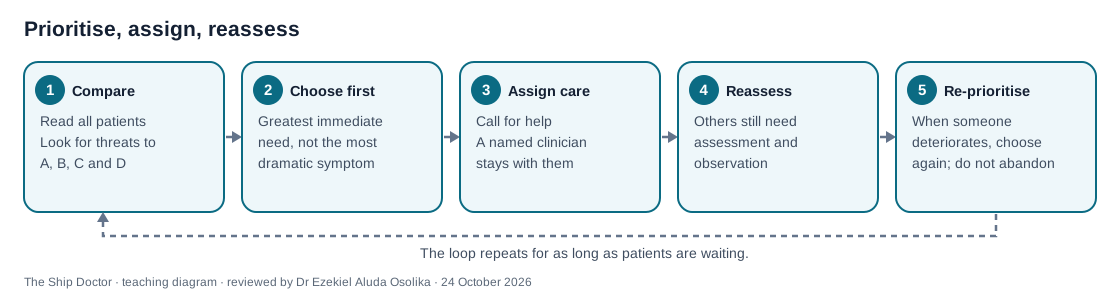
Local systems vary. “Who first” here is not the same as a category in ESI, the Manchester Triage System, CTAS or a mass-casualty tool, and the exercise does not map answers to any one of them. Use the system, escalation rules and role responsibilities of your own service.
Worked answers
Every scenario in full, with the correct answers and the reasoning. Open one when you have committed to your own answer.
Beginner: scenarios 1–4
Scenario 1 Airway before arrival order Beginner
Setting: Routine emergency or ward prioritisation with help available; not mass casualty triage.
- Patient A — 25 year old: ankle injury, pulse 82, normal breathing, foot warm and perfused.
- Patient B — 46 year old: new hoarse voice and stridor after a meal, struggling to speak.
- Patient C — 70 year old: mild dysuria, alert, BP 132/76, no systemic symptoms.
- Patient D — 30 year old: migraine like headache matching previous episodes, normal observations and neurologic examination.
Question 1: Who needs your attention first?
Answer: Patient B
Why: The airway symptoms and difficulty speaking indicate an immediate threat. Call for help and begin an ABCDE response within scope.
The others: A, C and D were initially physiologically stable in the information given; each still requires assessment, and D’s original presentation does not make later deterioration harmless.
Ten minutes later. A colleague now manages B. Patient D becomes unresponsive and is not breathing normally.
Question 2: Who needs your immediate attention now?
Answer: Patient D
Why: Activate the resuscitation response and assess for cardiac arrest immediately. B continues to need care by the colleague.
The first patient keeps a named clinician while you respond to the deterioration. Reassessment continues for everyone still waiting.
Scenario 2 A quiet breathing emergency Beginner
Setting: Routine emergency or ward prioritisation with help available; not mass casualty triage.
- Patient A — 19 year old: asthma symptoms, now exhausted, speaking single words, very poor air entry and SpO2 84% on air.
- Patient B — 41 year old: hand laceration, bleeding controlled, normal perfusion.
- Patient C — 58 year old: chronic back pain unchanged, normal observations and no new neurologic symptoms.
- Patient D — 24 year old: itchy localised rash without breathing, airway or circulatory symptoms.
Question 1: Who needs your attention first?
Answer: Patient A
Why: Exhaustion, poor air entry and hypoxaemia suggest life threatening respiratory compromise. A quieter chest is not necessarily improvement.
The others: B, C and D initially have no stated immediate ABC threat. The change in D requires a fresh priority decision.
Ten minutes later. A senior clinician is treating A. Patient D suddenly develops tongue swelling and stridor.
Question 2: Who needs your immediate attention now?
Answer: Patient D
Why: D now has an immediate airway threat and needs an emergency response while A’s clinician continues care.
The first patient keeps a named clinician while you respond to the deterioration. Reassessment continues for everyone still waiting.
Scenario 3 Visible bleeding and shock Beginner
Setting: Routine emergency or ward prioritisation with help available; not mass casualty triage.
- Patient A — 34 year old: small cut with oozing controlled by a dressing, BP 124/80.
- Patient B — 52 year old: vomiting blood, pale and sweaty, pulse 132, BP 78/44.
- Patient C — 28 year old: sore throat, swallowing fluids, normal voice and breathing.
- Patient D — 65 year old: routine prescription query, comfortable and alert.
Question 1: Who needs your attention first?
Answer: Patient B
Why: Heavy bleeding with marked hypotension and tachycardia indicates circulatory compromise. Escalate and assess immediately.
The others: Initial stability makes A, C and D lower priority than B in this snapshot; it does not remove the need for reassessment.
Ten minutes later. B is now with the resuscitation team. Patient C develops drooling, difficulty breathing and stridor.
Question 2: Who needs your immediate attention now?
Answer: Patient C
Why: New airway compromise changes C’s priority immediately; request airway capable help.
The first patient keeps a named clinician while you respond to the deterioration. Reassessment continues for everyone still waiting.
Scenario 4 Reduced consciousness Beginner
Setting: Routine emergency or ward prioritisation with help available; not mass casualty triage.
- Patient A — 76 year old: difficult to wake, glucose 2.1 mmol/L, pulse present, RR 12.
- Patient B — 20 year old: wrist injury with normal perfusion and no major bleeding.
- Patient C — 38 year old: dry cough for two days, RR 16 and SpO2 98% on air.
- Patient D — 45 year old: painful but small superficial burn, normal observations.
Question 1: Who needs your attention first?
Answer: Patient A
Why: Reduced consciousness with severe hypoglycaemia needs immediate assessment and treatment under protocol. Do not give an oral drink to a person unable to swallow safely.
The others: Pain severity matters, but the supplied information for B and D does not outweigh A’s immediate disability and airway risk.
Ten minutes later. A is improving with a clinician present. Patient C becomes cyanosed and cannot complete a sentence, SpO2 80%.
Question 2: Who needs your immediate attention now?
Answer: Patient C
Why: C now has an immediate breathing threat. Escalate while the original patient’s care continues.
The first patient keeps a named clinician while you respond to the deterioration. Reassessment continues for everyone still waiting.
Emergency: scenarios 5–8
Scenario 5 An urgent neurologic window Emergency
Setting: Routine emergency or ward prioritisation with help available; not mass casualty triage.
- Patient A — 29 year old: isolated ankle sprain, normal vital signs and perfusion.
- Patient B — 67 year old: new unilateral weakness and aphasia beginning 25 minutes ago, alert, airway protected, glucose 6.0 mmol/L.
- Patient C — 40 year old: stable minor skin infection without systemic illness.
- Patient D — 33 year old: uncomplicated medication refill request.
Question 1: Who needs your attention first?
Answer: Patient B
Why: There is no stated immediate ABC collapse, but the new focal neurologic deficit is time critical and needs urgent stroke pathway assessment.
The others: The rule is not simply that all neurologic symptoms always come first. This snapshot compares a time critical presentation with three stable minor presentations.
Ten minutes later. The stroke team is evaluating B. Patient A collapses and is not breathing normally.
Question 2: Who needs your immediate attention now?
Answer: Patient A
Why: A new possible cardiac arrest takes immediate priority while the stroke team continues B’s assessment.
The first patient keeps a named clinician while you respond to the deterioration. Reassessment continues for everyone still waiting.
Scenario 6 Pain can signal a circulatory emergency Emergency
Setting: Routine emergency or ward prioritisation with help available; not mass casualty triage.
- Patient A — 62 year old: sudden severe abdominal and back pain, pale, BP 76/46, pulse 124.
- Patient B — 31 year old: mild chronic knee pain, normal observations.
- Patient C — 23 year old: simple sore throat with normal speech and breathing.
- Patient D — 50 year old: chronic rash, stable observations.
Question 1: Who needs your attention first?
Answer: Patient A
Why: Severe acute pain plus shock physiology needs emergency assessment. Do not wait for a specific diagnostic label.
The others: B, C and D initially lack the severe physiology stated for A. The diagnosis of the abdominal emergency is deliberately not supplied.
Ten minutes later. A is now with a resuscitation clinician. Patient C rapidly develops swelling of the tongue and cannot speak.
Question 2: Who needs your immediate attention now?
Answer: Patient C
Why: This is a new immediate airway problem. Escalate and reassess without assuming the earlier sore throat assessment remains valid.
The first patient keeps a named clinician while you respond to the deterioration. Reassessment continues for everyone still waiting.
Scenario 7 Pregnancy does not change the need to assess physiology Emergency
Setting: Routine emergency or ward prioritisation with help available; not mass casualty triage.
- Patient A — 28 year old in late pregnancy: active generalised seizure, staff protecting from injury.
- Patient B — 22 year old: minor finger injury, perfusion normal.
- Patient C — 47 year old: stable long standing back pain without red flags in the provided history.
- Patient D — 36 year old: mild nausea, alert, normal observations.
Question 1: Who needs your attention first?
Answer: Patient A
Why: An active seizure threatens airway and breathing and requires an immediate obstetric and emergency response. Cause specific treatment follows the trained team’s protocol.
The others: The original information gives no immediate threat in B, C or D. Pregnancy alone is not the reason for the initial choice; the active seizure is.
Ten minutes later. The emergency and obstetric team is managing A. Patient D becomes unresponsive with slow breathing at 5/min.
Question 2: Who needs your immediate attention now?
Answer: Patient D
Why: D now needs immediate airway and breathing assessment and emergency support while A remains under the attending team’s care.
The first patient keeps a named clinician while you respond to the deterioration. Reassessment continues for everyone still waiting.
Scenario 8 Do not mistake drowsiness for improvement Emergency
Setting: Routine emergency or ward prioritisation with help available; not mass casualty triage.
- Patient A — 54 year old: after an analgesic, becomes barely rousable, RR 5, SpO2 82%, pulse present.
- Patient B — 60 year old: stable wound review, normal observations.
- Patient C — 27 year old: mild diarrhoea, drinking, BP 122/74.
- Patient D — 35 year old: isolated shoulder pain after sport, no deformity, normal perfusion.
Question 1: Who needs your attention first?
Answer: Patient A
Why: Markedly reduced ventilation and consciousness are immediate threats. Call for help and support breathing according to scope and protocol; determining the cause comes alongside stabilisation.
The others: The initial information for B, C and D is lower acuity. Medication exposure may explain A’s decline but must not replace a full assessment.
Ten minutes later. A has an airway trained clinician present. Patient C has a large episode of bleeding, becomes pale and BP falls to 70/40.
Question 2: Who needs your immediate attention now?
Answer: Patient C
Why: C now has circulatory compromise requiring immediate escalation. Do not leave either patient without assigned care.
The first patient keeps a named clinician while you respond to the deterioration. Reassessment continues for everyone still waiting.
Questions about this practice
Is this only for nurses?
No. The fictional prioritisation questions can also support medical, paramedic and student learning.
Does the most dramatic symptom always go first?
No. The current threat, physiology, time sensitivity and available information determine the priority in each scenario.
Is this mass-casualty triage?
No. The supplied cases assume routine care and help being available. Mass-casualty systems need their own training.
Educational disclaimer
Educational use only. These are generic prioritisation exercises in routine care with help available. They are not an official ESI, Manchester, CTAS or mass-casualty triage test. Educational fictional practice only. Not patient-specific advice or an assessment of clinical competence. Scores are informal feedback on one practice attempt; no pass mark, certificate or competence decision is made from them. Follow your supervision, scope of practice and local protocols.
Sources and further reading
- WHO ICRC MSF — Interagency Integrated Triage Tool
- Resuscitation Council UK — The ABCDE approach updated July 2024
Reference ranges, formulae and pathways vary between laboratories, services and countries. Use your own local guidance in practice.