
Educational scope: Independent practice stations for rehearsal and feedback; not official examination material. Free, with no account or email needed.
Written by Dr. Ezekiel Aluda Osolika, emergency physician (MBChB, FEBEM). Clinical content reviewed by the author on 24 October 2026; review covered the case histories, answers, explanations, calculations, image interpretation, annotation guides and teaching diagrams. This is author review, not an independent second review. All patients and orders are fictional. Content version 2026-10-24-1. Spotted an error? Report a correction and name the case ID.
Choose a station
Eight stations, each with candidate instructions, examiner information given only when asked, a ten-item checklist marked out of 20, concerns to discuss and a model debrief.
Candidate mode keeps the examiner information closed until you reveal it or end the station. Practise untimed, or start the optional timer inside the station.
ABCDE and escalation: stations 1–4
ABCDE assessment of a deteriorating ward patient
Candidate instructions
You are called to a fictional adult on a postoperative ward. The patient looks pale and says they feel faint. Demonstrate and explain your initial ABCDE approach, request available information, and give a concise escalation handover. State actions appropriate to your role.
Communication prompt: A colleague asks: “What do you need me to do first?” Give two specific tasks and ask for confirmation.
Examiner information and marking sheet
Information to give only when asked
- On entry
- Adult, pale and clammy. Speaking in short complete sentences.
- If asked about airway
- Airway currently patent, no stridor.
- If asked about breathing
- RR 28, SpO2 92% on air, bilateral air entry.
- If asked about circulation
- Pulse 128, BP 82/48, cool extremities and ongoing bleeding into a drain.
- If asked about disability
- Newly confused, glucose 6.4 mmol/L.
- If asked about exposure
- Postoperative wound and drain require inspection; maintain warmth and dignity.
- After escalation
- A senior clinician and resuscitation team are on their way. Ask the candidate what they reassess and hand over.
Marking checklist
0 = absent or incorrect · 1 = partial or prompted · 2 = clear and appropriate.
| # | Criterion | 0 | 1 | 2 |
|---|---|---|---|---|
| 1 | Recognises acute deterioration and asks for immediate help | |||
| 2 | Checks airway patency and readiness to support it | |||
| 3 | Assesses breathing including RR oxygen context and work of breathing | |||
| 4 | Assesses circulation including bleeding perfusion pulse and BP | |||
| 5 | Initiates appropriate monitoring and access with delegated support within role | |||
| 6 | Recognises shock and requests urgent cause directed treatment under local protocol | |||
| 7 | Assesses consciousness and bedside glucose | |||
| 8 | Examines relevant exposure findings while maintaining dignity and warmth | |||
| 9 | Reassesses after each intervention and arranges ongoing observation | |||
| 10 | Gives a concise SBAR including physiology bleeding concern and urgent request | |||
| Total | / 20 | |||
Concerns to discuss in feedback
- Fails to recognise shock or delays escalation while completing a long history
- Leaves the deteriorating patient without assigned supervision
Concerns are feedback points to discuss even when the score is high. They are not an official fail rule.
Model debrief
The central task is to recognise the immediate threat, call for help, assess and act in parallel, then reassess. Naming a precise bleeding source is less important than responding to the physiology.
Recognise and escalate adult anaphylaxis
Candidate instructions
A fictional 35 year old develops hoarseness, wheeze and hypotension soon after an IV medicine. Demonstrate recognition, immediate response and a team handover. Verbalise treatment within your professional scope and the stated local adult anaphylaxis protocol.
Communication prompt: The nurse asks: “Is this an IV adrenaline bolus?” Clarify the IM route for this adult initial response and the need for specialist management of refractory cases.
Examiner information and marking sheet
Information to give only when asked
- On entry
- Hoarse voice, wheeze, BP 82/48, pulse 128 and an erythematous rash.
- If asked about trigger
- Symptoms began during a new IV infusion.
- If asked about protocol
- For this station the service uses Resuscitation Council UK adult anaphylaxis guidance.
- If asked about adrenaline
- Available stock is clearly labelled adrenaline 1 mg/mL.
- After first response
- At a timed five minute review, airway and breathing symptoms persist; explain the next escalation and reassessment.
Marking checklist
0 = absent or incorrect · 1 = partial or prompted · 2 = clear and appropriate.
| # | Criterion | 0 | 1 | 2 |
|---|---|---|---|---|
| 1 | Recognises anaphylaxis from airway breathing or circulation compromise | |||
| 2 | Calls for resuscitation and airway capable help immediately | |||
| 3 | Stops the suspected trigger when feasible without delaying care | |||
| 4 | Assesses airway breathing and circulation and positions safely for the presentation | |||
| 5 | Requests or gives IM adrenaline under scope and the stated protocol | |||
| 6 | Correctly states the adult RCUK dose as 500 micrograms IM using 1 mg/mL stock when asked | |||
| 7 | Explains reassessment and repeat IM adrenaline after five minutes if no improvement under the protocol | |||
| 8 | Arranges oxygen monitoring IV access and fluid resuscitation through the treating team | |||
| 9 | Tracks response and treatment times and uses clear closed loop communication | |||
| 10 | Plans ongoing observation and senior care rather than ending the assessment after rash improvement | |||
| Total | / 20 | |||
Concerns to discuss in feedback
- Uses routine IV adrenaline bolus instead of the stated initial IM protocol
- Delays adrenaline for antihistamines in a patient with ABC compromise
- Allows the unstable patient to stand or walk
Concerns are feedback points to discuss even when the score is high. They are not an official fail rule.
Model debrief
Treat ABC compromise promptly and reassess. Rash is neither required for recognition nor an adequate marker of recovery. The dose applies to this explicitly adult RCUK station, not to children or a different protocol.
Assess severe breathlessness
Candidate instructions
A fictional adult with asthma is increasingly exhausted after initial treatment. Perform a focused ABCDE reassessment, communicate your concern and request appropriate help. You are not required to demonstrate airway procedures.
Communication prompt: The patient asks: “Does less wheezing mean I am better?” Explain simply that poor air movement can make the chest quieter and why the team is acting urgently.
Examiner information and marking sheet
Information to give only when asked
- On entry
- Speaking single words, respiratory rate 34, SpO2 85% on air.
- If asked about chest
- Very poor bilateral air entry with little audible wheeze.
- If asked about circulation
- Pulse 132, BP 98/62.
- If asked about disability
- Becoming drowsy.
- If asked about treatment
- Initial inhaled treatment is documented; the candidate should check response and ask for urgent senior review rather than assume the quiet chest means recovery.
Marking checklist
0 = absent or incorrect · 1 = partial or prompted · 2 = clear and appropriate.
| # | Criterion | 0 | 1 | 2 |
|---|---|---|---|---|
| 1 | Recognises life threatening respiratory compromise | |||
| 2 | Calls for senior airway and resuscitation support early | |||
| 3 | Checks airway and ability to speak | |||
| 4 | Describes work of breathing air entry RR and oxygenation | |||
| 5 | Interprets exhaustion poor air entry and drowsiness as danger signs | |||
| 6 | Requests immediate treatment and oxygen under the local protocol | |||
| 7 | Assesses circulation and arranges appropriate monitoring | |||
| 8 | Reassesses consciousness and checks for reversible contributors | |||
| 9 | Prepares for deterioration with delegated tasks and equipment appropriate to role | |||
| 10 | Gives a focused handover including trend treatment already given and concern | |||
| Total | / 20 | |||
Concerns to discuss in feedback
- Reassures solely because wheeze is quieter
- Delays escalation despite drowsiness and poor air entry
Concerns are feedback points to discuss even when the score is high. They are not an official fail rule.
Model debrief
Assessment must follow the physiology and trend. A patient tiring during severe breathlessness can deteriorate even when the audible examination seems less dramatic.
An unresponsive patient with low glucose
Candidate instructions
A fictional adult is difficult to wake. Assess immediate threats, request bedside tests and describe a safe initial response and handover within your role.
Communication prompt: A relative offers a sugary drink. Explain why an unconscious or poorly responsive person must not be given a drink.
Examiner information and marking sheet
Information to give only when asked
- On entry
- Pulse present, RR 10, gurgling respirations, responds only to pain.
- If asked about glucose
- Glucose 2.0 mmol/L.
- If asked about history
- Known diabetes; meal and medication history are incomplete.
- If asked about treatment
- Use the local hypoglycaemia protocol and a route appropriate to consciousness and access. No oral intake is safe until swallowing is assessed.
- After treatment
- Glucose improves and the patient becomes more responsive; ask the candidate about repeat assessment and ongoing risk.
Marking checklist
0 = absent or incorrect · 1 = partial or prompted · 2 = clear and appropriate.
| # | Criterion | 0 | 1 | 2 |
|---|---|---|---|---|
| 1 | Calls for urgent help and checks pulse and breathing | |||
| 2 | Addresses airway patency and protects the airway within scope | |||
| 3 | Assesses breathing and arranges support and monitoring | |||
| 4 | Requests immediate bedside glucose | |||
| 5 | Recognises clinically significant hypoglycaemia in context | |||
| 6 | Uses an appropriate non oral treatment route under the local protocol | |||
| 7 | Avoids giving oral fluid or food to a person unable to swallow safely | |||
| 8 | Rechecks glucose consciousness airway and response | |||
| 9 | Seeks the cause and risk of recurrence rather than stopping at one improved reading | |||
| 10 | Hands over intervention times response and need for continuing observation | |||
| Total | / 20 | |||
Concerns to discuss in feedback
- Gives oral drink to a patient unable to protect the airway
- Fails to reassess after treatment
Concerns are feedback points to discuss even when the score is high. They are not an official fail rule.
Model debrief
Correcting the glucose is part of resuscitation. Airway safety, reassessment and recurrence prevention remain essential. This station deliberately defers drug choice and dose to a verified local protocol.
Prehospital and remote communication: stations 5–6
Stroke assessment and pre alert
Candidate instructions
A fictional 72 year old has new arm weakness and difficulty speaking. Perform a focused assessment, identify critical information and give an ambulance to hospital pre alert.
Communication prompt: The relative asks: “Can you promise it is not a bleed?” Explain that the stroke subtype requires further assessment and imaging.
Examiner information and marking sheet
Information to give only when asked
- On entry
- Alert, airway protected, new right arm weakness and speech difficulty.
- If asked about time
- Last known well 09:10; symptoms noticed 09:20.
- If asked about glucose
- 6.2 mmol/L.
- If asked about observations
- BP 168/94, pulse 88, RR 18, SpO2 96% on air.
- If asked about medication
- Anticoagulant use has not yet been confirmed.
- Transport
- Estimated arrival 12 minutes through the local stroke pathway.
Marking checklist
0 = absent or incorrect · 1 = partial or prompted · 2 = clear and appropriate.
| # | Criterion | 0 | 1 | 2 |
|---|---|---|---|---|
| 1 | Checks for immediate airway breathing and circulation threats | |||
| 2 | Recognises a possible acute stroke without claiming the subtype is known | |||
| 3 | Establishes and clearly states last known well | |||
| 4 | Distinguishes onset or discovery time from last known well | |||
| 5 | Checks bedside glucose and acknowledges alternative causes | |||
| 6 | Performs or requests a focused neurologic assessment | |||
| 7 | Checks relevant medication including anticoagulants or flags uncertainty | |||
| 8 | Uses the appropriate local destination and stroke pathway | |||
| 9 | Gives a concise pre alert with deficits time glucose and arrival estimate | |||
| 10 | Reassesses during transfer and communicates any change | |||
| Total | / 20 | |||
Concerns to discuss in feedback
- Delays the stroke pathway for nonessential tasks
- Claims a stroke subtype or eligibility for a specific treatment without required information
Concerns are feedback points to discuss even when the score is high. They are not an official fail rule.
Model debrief
The useful handover supplies the time window, physiology, deficit and key unknowns. It does not invent imaging findings or treatment eligibility.
A remote transfer request
Candidate instructions
At a fictional remote clinic, an adult with a chest infection is deteriorating. Give an initial management overview and a retrieval request that accounts for limited resources.
Communication prompt: The coordinator asks: “Can you wait four hours?” Explain the current risk, what support is available, what is uncertain and what contingency you need.
Examiner information and marking sheet
Information to give only when asked
- On entry
- RR 32, SpO2 88% despite the current oxygen device, pulse 126, BP 90/54 and new confusion.
- Resources
- One colleague, basic monitoring and oxygen. No critical care team on site.
- Travel
- Definitive care is about four hours away, subject to transport conditions.
- If asked about oxygen
- The device and setting must be read from the actual equipment record; do not invent a reserve duration.
- If asked about transfer
- A retrieval clinician can provide advice and coordinate destination and transport.
Marking checklist
0 = absent or incorrect · 1 = partial or prompted · 2 = clear and appropriate.
| # | Criterion | 0 | 1 | 2 |
|---|---|---|---|---|
| 1 | Recognises high risk deterioration and calls for help | |||
| 2 | Repeats ABCDE and addresses immediate threats within resources | |||
| 3 | Checks oxygen device setting response and available reserve | |||
| 4 | States the limits of local capability explicitly | |||
| 5 | Requests retrieval advice early and identifies the receiving service | |||
| 6 | Reports physiology and trend rather than only a diagnostic label | |||
| 7 | Accounts for travel time staffing equipment and monitoring during transfer | |||
| 8 | Asks for and reads back an interim plan and deterioration triggers | |||
| 9 | Assigns ongoing observation and reassessment while awaiting transfer | |||
| 10 | Documents the request advice responsibilities and next review time | |||
| Total | / 20 | |||
Concerns to discuss in feedback
- Promises safe prolonged holding without checking capability and supplies
- Requests transport but leaves no interim care plan
Concerns are feedback points to discuss even when the score is high. They are not an official fail rule.
Model debrief
A useful remote handover joins clinical urgency to operational facts. Do not calculate an oxygen endurance without verified cylinder volume, pressure, device use and reserve assumptions.
Interpretation and explaining uncertainty: stations 7–8
Explain an ABG that suggests deteriorating ventilation
Candidate instructions
A fictional adult with metabolic acidosis becomes exhausted. Interpret pH 7.02, PaCO2 40 mmHg and bicarbonate 10 mmol/L, then communicate the significance to the senior clinician.
Communication prompt: Explain the result in two plain sentences to a colleague who says: “But the CO2 is normal.”
Examiner information and marking sheet
Information to give only when asked
- On entry
- Arterial sample. Oxygenation and full chemistry are not supplied.
- If asked about history
- Known ketoacidosis with worsening drowsiness.
- If asked about formula
- The candidate may use the supplied Winter’s formula: expected PaCO2 = 1.5 × bicarbonate + 8 ± 2.
- Examiner prompt
- Why is a PaCO2 of 40 not reassuring here?
Marking checklist
0 = absent or incorrect · 1 = partial or prompted · 2 = clear and appropriate.
| # | Criterion | 0 | 1 | 2 |
|---|---|---|---|---|
| 1 | Verifies arterial sample units and clinical context | |||
| 2 | Recognises marked acidemia | |||
| 3 | Identifies the primary metabolic acidosis | |||
| 4 | Calculates expected PaCO2 as 23 plus or minus 2 mmHg | |||
| 5 | Compares the measured value with the expected range | |||
| 6 | Recognises additional respiratory acidosis or an inadequate ventilatory response | |||
| 7 | Explains why a normal range CO2 can be abnormal in this situation | |||
| 8 | Links the pattern to the clinical deterioration and escalates urgently | |||
| 9 | Avoids giving an unsupported ventilator prescription from a single gas | |||
| 10 | Hands over the values reasoning and immediate concern clearly | |||
| Total | / 20 | |||
Concerns to discuss in feedback
- Labels the gas adequately compensated because PaCO2 is in the reference range
- Delays escalation despite exhaustion and severe acidemia
Concerns are feedback points to discuss even when the score is high. They are not an official fail rule.
Model debrief
The key comparison is measured versus expected CO2 in metabolic acidosis. Interpretation must lead back to the patient, available expertise and urgent reassessment.
Communicate uncertainty after a normal chest film
Candidate instructions
A fictional adult with continuing pleuritic chest pain has a chest radiograph without a focal acute abnormality. Explain what the result means, assess understanding and describe the next assessment plan without false reassurance.
Communication prompt: Patient: “So I am definitely fine?” Answer directly, empathetically and without either alarmism or an unsupported guarantee.
Examiner information and marking sheet
Information to give only when asked
- On entry
- The patient asks whether a normal film means there cannot be anything serious.
- If asked about history
- The clinical assessment is not complete; additional risk factors and observations need checking.
- If asked about plan
- The candidate should explain that the treating team will use history examination observations and an appropriate pathway to decide further tests or care.
- Examiner prompt
- Ask the candidate to use teach back and state symptoms that should trigger immediate re escalation while the patient remains in care.
Marking checklist
0 = absent or incorrect · 1 = partial or prompted · 2 = clear and appropriate.
| # | Criterion | 0 | 1 | 2 |
|---|---|---|---|---|
| 1 | Introduces role and checks the patient’s main concern | |||
| 2 | Explains the actual radiographic finding plainly | |||
| 3 | States that a normal film does not exclude every important cause | |||
| 4 | Avoids diagnosing anxiety or excluding pulmonary embolism from the image alone | |||
| 5 | Acknowledges what information is still needed | |||
| 6 | Explains the next clinical assessment steps without unsupported promises | |||
| 7 | Checks for current deterioration and maintains appropriate urgency | |||
| 8 | Invites questions and explores barriers to understanding | |||
| 9 | Uses teach back to confirm the patient’s understanding | |||
| 10 | Gives a clear immediate escalation plan for worsening breathlessness collapse or other deterioration | |||
| Total | / 20 | |||
Concerns to discuss in feedback
- Gives a guarantee of no serious disease from the radiograph alone
- Discharges the fictional patient without completing the clinical assessment
Concerns are feedback points to discuss even when the score is high. They are not an official fail rule.
Model debrief
Good communication states what is known, what remains uncertain and what happens next. A reassuring image is useful evidence, not a guarantee.
Printable marking sheets
Print the candidate sheet and the examiner sheet separately so answers are not handed to the candidate. On this page, choose a station and use Print candidate sheet or Print examiner sheet; navigation, timers and buttons are left off the printout. All eight examiner sheets are also in one PDF.
Download the eight examiner sheets (PDF)
How to practise
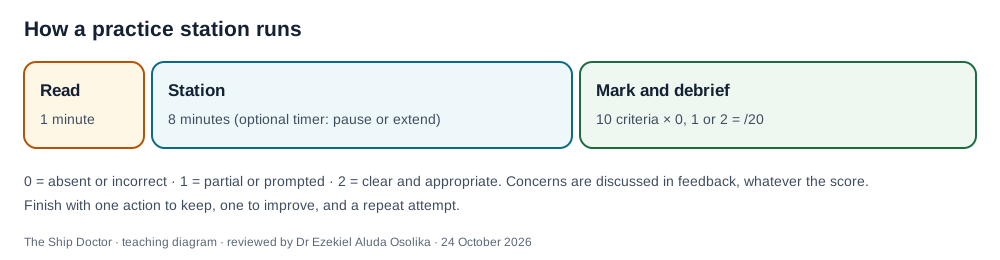
- Read the candidate instructions and decide your role. Use the optional one-minute reading period and eight-minute station timer, or practise untimed.
- In paired practice, the examiner reveals only the supplied information when requested. Mark each criterion 0 for absent or incorrect, 1 for partial or prompted, or 2 for clear and appropriate performance.
- Discuss critical concerns explicitly even when the numerical score is high. A checklist score is feedback on one practice attempt, not proof of competence or a prediction of an official examination result.
- Finish with one action to keep, one action to improve and a repeat attempt. Print candidate instructions separately from examiner answers.
These are independently written educational stations. They are not official MRCEM, EUSEM or nursing examination materials, and the marks are not an official pass threshold.
Questions about this practice
Are these official MRCEM OSCE stations?
No. They are independently authored educational practice stations and are not official examination questions or endorsed marking schemes.
Can I practise without a timer?
Yes. Timing is optional and can be paused or extended.
Can I print the marking sheets?
Yes. Use the station’s examiner print view or the supplied marking-sheet PDF.
Educational disclaimer
Educational use only. These stations are for rehearsal and feedback. A checklist score reflects one practice attempt and is not proof of competence or a prediction of an examination result. Educational fictional practice only. Not patient-specific advice or an assessment of clinical competence. Scores are informal feedback on one practice attempt; no pass mark, certificate or competence decision is made from them. Follow your supervision, scope of practice and local protocols.
Sources and further reading
- Resuscitation Council UK — The ABCDE approach updated July 2024
- AHRQ TeamSTEPPS — SBAR tool
- Resuscitation Council UK — Special circumstances guidelines 2025
Reference ranges, formulae and pathways vary between laboratories, services and countries. Use your own local guidance in practice.