
Who this is for: students, nurses, paramedics and doctors who interpret or escalate blood gases. It teaches interpretation on fictional values; it is not a diagnostic tool, and your local laboratory ranges and protocols apply.
Author and review
Written by Dr. Ezekiel Aluda Osolika, emergency physician (MBChB, FEBEM). Clinical content reviewed by the author on 12 November 2026; the review covered the whole lesson: the learning outcome, routing questions, explanations, worked example and self-check. The method, reference ranges, formulas and worked example are reused from the ABG practice page, last reviewed 24 October 2026. This is author review, not an independent second review (see clinical governance). All values are fictional. Content version 2026-11-12-1.
Where should you start?
Three optional questions. They are not scored and only suggest where to begin.
- Can you say whether a pH of 7.31 is acidaemia or alkalaemia? If not, start with step 2 below, then the beginner cases 1–6.
- Can you calculate an expected PaCO2 for a metabolic acidosis? If not, read step 4 and work the example.
- Can a normal pH hide a mixed disorder? If you are not sure, the worked example is for you; then try the advanced cases 14–20.
How do you interpret an ABG step by step?
First confirm the sample and units. Check pH, identify the process that explains its direction, and compare the other values with the response expected for that process. Interpret oxygenation separately using the clinical setting and oxygen delivery information.
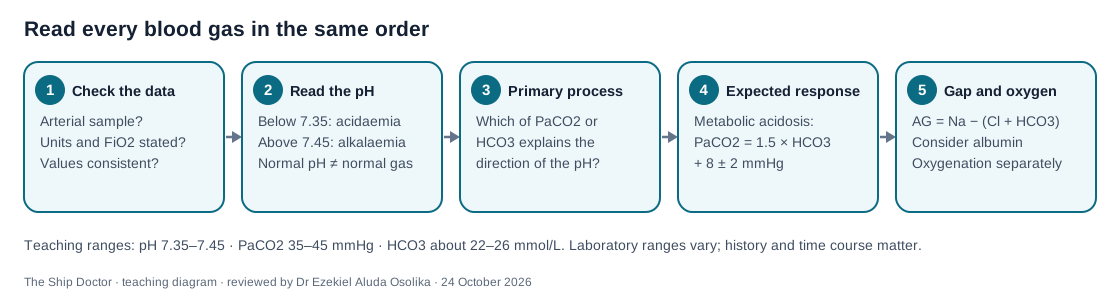
- Check the data. Arterial sample, units (mmHg or kPa; kPa = mmHg ÷ 7.50062) and inspired oxygen recorded.
- Read the pH. Teaching reference ranges are pH 7.35–7.45, PaCO2 35–45 mmHg (4.7–6.0 kPa) and bicarbonate about 22–26 mmol/L. Reference intervals vary by laboratory.
- Find the primary process that explains the direction of the pH.
- Compare the expected response. For metabolic acidosis, expected PaCO2 = 1.5 × bicarbonate + 8 ± 2 mmHg. A measured value above that range suggests an additional respiratory acidosis; one below suggests an additional respiratory alkalosis. Compensation rules are approximate; history and time course matter.
- Anion gap and oxygenation, separately. Anion gap here excludes potassium: sodium − (chloride + bicarbonate). Use the laboratory’s reference and consider albumin. Interpret oxygenation against the oxygen being delivered.
Can a normal pH hide a mixed disorder?
Yes. Two opposing processes can cancel each other’s effect on the pH, so a pH of 7.40 with a very abnormal PaCO2 and bicarbonate is a reason to keep going, not to stop. The expected-response check in step 4 is what exposes the second process.
| pH | 7.40 |
|---|---|
| PaCO2 | 20 mmHg (2.7 kPa) |
| HCO3 (calculated) | 12 mmol/L |
| PaO2 | 98 mmHg (13.1 kPa) on FiO2 0.21 |
| Sodium / chloride | 140 / 104 mmol/L |
| Albumin | 4 g/dL |
Show the worked answer
- pH is 7.40, but bicarbonate and CO2 are both very low.
- Anion gap = 140 − (104 + 12) = 24.
- Winter’s expected PaCO2 is 26 ± 2; 20 is too low for compensation alone.
- The mixed pattern fits the fictional exposure history but does not establish a toxin concentration or treatment plan.
Interpretation: high anion gap metabolic acidosis with respiratory alkalosis.
Common mistakes
- Normal pH is not the same as a normal gas.
- Reading the PaO2 without the FiO2.
- Skipping the expected-response check, so a second disorder is missed.
- Forgetting albumin when reading the anion gap.
Self-check
Answer these, then use the result to choose your next step. Nothing is scored or stored.
- What is the expected PaCO2 when bicarbonate is 14 mmol/L in a metabolic acidosis?
Show the answer
1.5 × 14 + 8 = 29 mmHg, range 27–31 mmHg. Not sure? Re-read step 4, then try intermediate cases 7–13.
- Sodium 138, chloride 100, bicarbonate 18 mmol/L. What is the anion gap?
Show the answer
138 − (100 + 18) = 20 mmol/L, before any albumin adjustment. Not sure? Re-read step 5.
- Why must FiO2 be recorded with every gas?
Show the answer
The same PaO2 means different things at different inspired oxygen; oxygenation is read against what is delivered.
Next: work the beginner cases 1–6, or go back to the ABG hub.
Sources
- Merck Manual Professional — Primary changes and compensations in simple acid base disorders
- University of Colorado — Evaluation of acid base disorders teaching handout
Spotted an error? Report a correction.