
Educational scope: Fictional arterial gases for learning interpretation; not a diagnostic tool. Free, with no account or email needed.
Written by Dr. Ezekiel Aluda Osolika, emergency physician (MBChB, FEBEM). Clinical content reviewed by the author on 24 October 2026; review covered the case histories, answers, explanations, calculations, image interpretation, annotation guides and teaching diagrams. This is author review, not an independent second review. All patients and orders are fictional. Content version 2026-10-24-1. Spotted an error? Report a correction and name the case ID.
Start ABG practice
Choose a set, then work one case at a time. Each case has two scored questions: the interpretation, then the check that supports it. Bicarbonate is shown as the calculated value, and every sample is arterial.
The interactive practice needs JavaScript. Every case, answer and explanation is also written out in the worked answers below.
How do you interpret an ABG step by step?
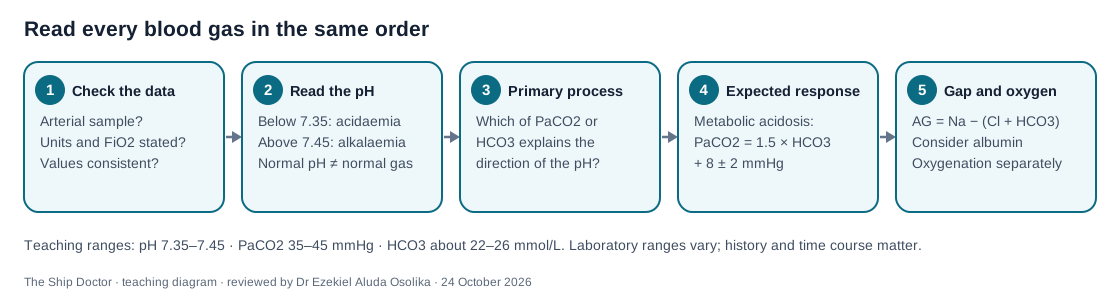
- First confirm the sample and units. Check pH, identify the process that explains its direction, and compare the other values with the response expected for that process. Interpret oxygenation separately using the clinical setting and oxygen delivery information.
- Teaching reference ranges are pH 7.35–7.45, PaCO2 35–45 mmHg and bicarbonate about 22–26 mmol/L. Reference intervals vary by laboratory. The equations use reference PaCO2 40 and bicarbonate 24. Compensation rules are approximate; history and time course matter.
- For metabolic acidosis, expected PaCO2 = 1.5 × bicarbonate + 8 ± 2 mmHg. A measured value above that range suggests an additional respiratory acidosis; one below suggests an additional respiratory alkalosis.
- For metabolic alkalosis, this module uses an approximate CO2 rise of 0.6–0.75 mmHg for each 1 mmol/L bicarbonate rise above 24. For respiratory disorders, distinguish acute from chronic responses using the history and the source table linked below.
- Anion gap here excludes potassium: sodium − (chloride + bicarbonate). Use the laboratory’s reference and consider albumin. A normal pH can coexist with important opposing disturbances. Do not use a single score or formula as a clinical decision on its own.
Common ABG interpretation mistakes
- Reading the PaO2 without the FiO2. A PaO2 of 100 mmHg is unremarkable on room air and a serious gas-exchange problem on an FiO2 of 0.6. Interpret oxygenation against the oxygen being delivered.
- Calling a normal pH “fully compensated”. Compensation rarely returns the pH all the way to normal. A normal pH with an abnormal PaCO2 and an abnormal bicarbonate should make you look for two opposing processes (case 16 shows this).
- Skipping the expected-response check. Without the expected PaCO2 or bicarbonate for the primary process, a second disorder is easy to miss.
- Forgetting albumin in the anion gap. Low albumin lowers the measured gap, so a raised-gap acidosis can hide behind a “normal” number. A common approximation adds about 2.5 mmol/L to the gap for every 1 g/dL that albumin falls below 4 g/dL (case 15).
- Treating the gas, not the patient. The same numbers mean different things in a fit adult, a patient with chronic CO2 retention and a patient who is tiring. The history and the trend decide what the result means.
Worked ABG cases with answers
Every case in full, with the correct answers and the reasoning. Open one when you have committed to your own answer.
Beginner: cases 1–6
Case 1 A reference gas Beginner
An adult is comfortable at rest at sea level. This is a reference exercise, not a test excluding all disease.
| pH | 7.40 |
|---|---|
| PaCO2 | 40 mmHg |
| HCO3 (calculated) | 24 mmol/L |
| PaO2 | 95 mmHg |
| FiO2 | 0.21 (room air) |
Question 1: Which interpretation best fits the data and history?
Answer: No acid base disturbance is apparent
Question 2: Which statement best checks your interpretation?
Answer: The acid base values are in the teaching reference ranges; this does not exclude illness
Worked answer
- pH 7.40 lies within the teaching range 7.35–7.45.
- PaCO2 40 mmHg and bicarbonate 24 mmol/L are close to the reference values used in this module.
- There is no abnormal primary process for which to calculate compensation. PaO2 95 on room air is not concerning in this fictional context.
Common mistake: A reference gas is not a rule out test for a serious diagnosis.
Case 2 Ketones and fast breathing Beginner
An adult with known diabetes has vomiting, dehydration and a raised blood ketone measurement.
| pH | 7.29 |
|---|---|
| PaCO2 | 26 mmHg |
| HCO3 (calculated) | 12 mmol/L |
| PaO2 | 98 mmHg |
| FiO2 | 0.21 (room air) |
| Sodium | 140 mmol/L |
| Chloride | 102 mmol/L |
| Albumin | 4 g/dL |
Question 1: Which interpretation best fits the data and history?
Answer: High anion gap metabolic acidosis with expected respiratory compensation
Question 2: Which statement best checks your interpretation?
Answer: Winter’s expected PaCO2 is 26 plus or minus 2 mmHg
Worked answer
- pH 7.29 is acidemic and bicarbonate 12 is low.
- Anion gap = 140 − (102 + 12) = 26 mmol/L, above this exercise’s reference 8–12.
- Winter’s formula = 1.5 × 12 + 8 = 26 ± 2 mmHg. Measured PaCO2 26 fits.
- The gas supports the acid base pattern; the diagnosis and treatment require clinical and metabolic assessment.
Common mistake: Low PaCO2 can be appropriate compensation, rather than a separate primary disorder.
Case 3 Losses from the gut Beginner
An adult has several days of profuse diarrhoea. Albumin is normal.
| pH | 7.32 |
|---|---|
| PaCO2 | 32 mmHg |
| HCO3 (calculated) | 16 mmol/L |
| PaO2 | 96 mmHg |
| FiO2 | 0.21 (room air) |
| Sodium | 138 mmol/L |
| Chloride | 110 mmol/L |
| Albumin | 4 g/dL |
Question 1: Which interpretation best fits the data and history?
Answer: Normal anion gap metabolic acidosis with expected respiratory compensation
Question 2: Which statement best checks your interpretation?
Answer: Anion gap is 12 and expected PaCO2 is 32 plus or minus 2 mmHg
Worked answer
- pH 7.32 and bicarbonate 16 identify metabolic acidosis.
- Anion gap = 138 − (110 + 16) = 12 mmol/L.
- Expected PaCO2 = 1.5 × 16 + 8 = 32 ± 2. Measured 32 fits.
- The context is compatible with gastrointestinal bicarbonate loss.
Common mistake: Normal gap and normal acid base balance mean different things.
Case 4 Persistent vomiting Beginner
An adult has persistent vomiting. The scenario concerns the gas pattern, not an instruction to replace a particular fluid or electrolyte.
| pH | 7.50 |
|---|---|
| PaCO2 | 48 mmHg |
| HCO3 (calculated) | 36 mmol/L |
| PaO2 | 92 mmHg |
| FiO2 | 0.21 (room air) |
Question 1: Which interpretation best fits the data and history?
Answer: Metabolic alkalosis with a compatible respiratory response
Question 2: Which statement best checks your interpretation?
Answer: A PaCO2 around 47–49 mmHg is compatible with the raised bicarbonate
Worked answer
- pH 7.50 is alkalemic; bicarbonate 36 is raised.
- Bicarbonate has risen 12 above the reference 24.
- A PaCO2 rise of approximately 0.6–0.75 × 12 gives 47.2–49 mmHg. Measured 48 is compatible.
- These are approximate teaching rules, not exact physiologic boundaries.
Common mistake: Judge PaCO2 in relation to the primary metabolic change.
Case 5 Reduced ventilation after sedation Beginner
Soon after sedation, an adult becomes drowsy and breathes slowly. The gas was obtained while help and airway support were being arranged.
| pH | 7.26 |
|---|---|
| PaCO2 | 60 mmHg |
| HCO3 (calculated) | 26 mmol/L |
| PaO2 | 61 mmHg |
| FiO2 | 0.21 (room air) |
Question 1: Which interpretation best fits the data and history?
Answer: Acute respiratory acidosis with hypoxaemia
Question 2: Which statement best checks your interpretation?
Answer: An acute bicarbonate rise of roughly 2–4 mmol/L is expected for this CO2 rise
Worked answer
- pH 7.26 is acidemic and PaCO2 60 is raised.
- The short time course supports an acute ventilatory problem.
- For a 20 mmHg CO2 rise, an acute bicarbonate response of about 2–4 mmol/L is plausible; measured 26 fits the lower end.
- PaO2 61 on air is low. The bedside breathing problem needs immediate assessment, not just a label.
Common mistake: Do not delay assessment of ventilation while completing a calculation.
Case 6 Sudden rapid breathing Beginner
An adult has sudden tachypnoea and chest discomfort. The cause has not yet been established.
| pH | 7.62 |
|---|---|
| PaCO2 | 20 mmHg |
| HCO3 (calculated) | 20 mmol/L |
| PaO2 | 100 mmHg |
| FiO2 | 0.21 (room air) |
Question 1: Which interpretation best fits the data and history?
Answer: Acute respiratory alkalosis
Question 2: Which statement best checks your interpretation?
Answer: A small acute bicarbonate fall is compatible; the cause of hyperventilation remains unresolved
Worked answer
- pH 7.62 is alkalemic and PaCO2 20 is low.
- The CO2 has fallen 20 mmHg below 40.
- An acute bicarbonate decrease of about 2–4 mmol/L is compatible; measured bicarbonate 20 fits.
- Pain, hypoxaemia, pulmonary vascular disease and other causes need clinical consideration; do not infer anxiety from the gas alone.
Common mistake: A physiologic pattern is not a diagnosis of its cause.
Intermediate: cases 7–13
Case 7 A documented chronic baseline Intermediate
A stable adult with chronic hypercapnic lung disease has prior similar gases over several weeks.
| pH | 7.35 |
|---|---|
| PaCO2 | 60 mmHg |
| HCO3 (calculated) | 32 mmol/L |
| PaO2 | 62 mmHg |
| FiO2 | 0.21 (room air) |
Question 1: Which interpretation best fits the data and history?
Answer: Chronic respiratory acidosis with an expected bicarbonate response
Question 2: Which statement best checks your interpretation?
Answer: For a 20 mmHg CO2 rise, bicarbonate around 30–32 mmol/L is expected chronically
Worked answer
- PaCO2 60 is raised and the documented time course is chronic.
- A chronic rise of approximately 3–4 mmol/L per 10 mmHg gives bicarbonate 30–32.
- Measured bicarbonate 32 is compatible; pH rounds to 7.35 and must not be called normal solely from that rounding.
- PaO2 62 is low on air and still needs interpretation in the clinical context.
Common mistake: Use the prior gas and time course; one sample does not establish chronicity.
Case 8 A sustained low CO2 Intermediate
An adult has a documented sustained hyperventilatory state over several days. No sudden change is described.
| pH | 7.42 |
|---|---|
| PaCO2 | 30 mmHg |
| HCO3 (calculated) | 19 mmol/L |
| PaO2 | 94 mmHg |
| FiO2 | 0.21 (room air) |
Question 1: Which interpretation best fits the data and history?
Answer: Chronic respiratory alkalosis with a compatible bicarbonate response
Question 2: Which statement best checks your interpretation?
Answer: A chronic bicarbonate fall to about 19–20 mmol/L fits a 10 mmHg CO2 fall
Worked answer
- PaCO2 30 is low. The history supplies the sustained time course.
- The chronic bicarbonate response is approximately a fall of 4–5 mmol/L per 10 mmHg CO2 reduction.
- Bicarbonate 19 and pH 7.42 are compatible. The clinical cause still needs assessment.
Common mistake: A pH within the reference interval can coexist with a compensated disorder.
Case 9 The expected breathing response is missing Intermediate
An adult with ketoacidosis becomes exhausted and less responsive.
| pH | 7.02 |
|---|---|
| PaCO2 | 40 mmHg |
| HCO3 (calculated) | 10 mmol/L |
| PaO2 | 70 mmHg |
| FiO2 | 0.21 (room air) |
Question 1: Which interpretation best fits the data and history?
Answer: Metabolic acidosis with additional respiratory acidosis
Question 2: Which statement best checks your interpretation?
Answer: Expected PaCO2 is 23 plus or minus 2; measured 40 is inappropriately high
Worked answer
- pH 7.02 indicates marked acidemia.
- Bicarbonate 10 identifies metabolic acidosis.
- Winter’s expected PaCO2 = 1.5 × 10 + 8 = 23 ± 2 mmHg.
- Measured 40 is well above that range, indicating an added respiratory acidosis in this context. The deterioration requires urgent senior assessment.
Common mistake: Normal range CO2 can be dangerous when a low CO2 is needed for compensation.
Case 10 An alkalemic patient with a metabolic acidosis Intermediate
An adult with infection and circulatory compromise is breathing rapidly. Lactate is raised.
| pH | 7.47 |
|---|---|
| PaCO2 | 20 mmHg |
| HCO3 (calculated) | 14 mmol/L |
| PaO2 | 85 mmHg |
| FiO2 | 0.21 (room air) |
| Sodium | 140 mmol/L |
| Chloride | 102 mmol/L |
| Albumin | 4 g/dL |
Question 1: Which interpretation best fits the data and history?
Answer: Metabolic acidosis with additional respiratory alkalosis
Question 2: Which statement best checks your interpretation?
Answer: Expected PaCO2 is 29 plus or minus 2; measured 20 is lower than expected
Worked answer
- Bicarbonate 14 is low despite the alkalemic pH of 7.47.
- Expected PaCO2 = 1.5 × 14 + 8 = 29 ± 2.
- Measured 20 is lower than expected, supporting an additional respiratory alkalosis.
- Anion gap = 140 − (102 + 14) = 24 mmol/L.
Common mistake: Name all supported processes rather than letting the direction of pH hide one.
Case 11 Acidosis with renal impairment Intermediate
An adult with substantial renal impairment has nausea and tachypnoea. Albumin is normal.
| pH | 7.29 |
|---|---|
| PaCO2 | 26 mmHg |
| HCO3 (calculated) | 12 mmol/L |
| PaO2 | 93 mmHg |
| FiO2 | 0.21 (room air) |
| Sodium | 142 mmol/L |
| Chloride | 104 mmol/L |
| Albumin | 4 g/dL |
Question 1: Which interpretation best fits the data and history?
Answer: High anion gap metabolic acidosis with expected respiratory compensation
Question 2: Which statement best checks your interpretation?
Answer: Anion gap is 26 and PaCO2 26 matches Winter’s expected value
Worked answer
- pH 7.29 and low bicarbonate indicate metabolic acidosis.
- Anion gap = 142 − (104 + 12) = 26.
- Expected PaCO2 is 26 ± 2; measured 26 fits.
- The case is consistent with the context but a raised gap still requires clinical evaluation for its contributors.
Common mistake: A plausible context does not exclude other contributors to a raised anion gap.
Case 12 Acute deterioration from a chronic baseline Intermediate
A prior stable gas was PaCO2 60 and bicarbonate 32. Over the last hour the patient has become drowsier. Current oxygen is a controlled FiO2 of 0.28.
| pH | 7.25 |
|---|---|
| PaCO2 | 80 mmHg |
| HCO3 (calculated) | 34 mmol/L |
| PaO2 | 58 mmHg |
| FiO2 | 0.28 |
Question 1: Which interpretation best fits the data and history?
Answer: Acute on chronic respiratory acidosis
Question 2: Which statement best checks your interpretation?
Answer: The prior baseline and acute CO2 increase explain the modest further bicarbonate rise
Worked answer
- The baseline already documented chronic hypercapnia.
- PaCO2 has acutely risen another 20 mmHg, while bicarbonate rose from 32 to 34.
- An acute buffering response on top of a chronic baseline fits pH 7.25.
- PaO2 is low despite supplemental oxygen. Interpret the whole clinical deterioration urgently.
Common mistake: Do not apply an isolated chronic equation while ignoring the known baseline.
Case 13 More bicarbonate than compensation predicts Intermediate
An adult with chronic hypercapnia has several days of vomiting and recent diuretic exposure.
| pH | 7.50 |
|---|---|
| PaCO2 | 60 mmHg |
| HCO3 (calculated) | 45 mmol/L |
| PaO2 | 65 mmHg |
| FiO2 | 0.21 (room air) |
Question 1: Which interpretation best fits the data and history?
Answer: Respiratory acidosis with additional metabolic alkalosis
Question 2: Which statement best checks your interpretation?
Answer: Expected chronic bicarbonate is about 30–32, well below the measured 45
Worked answer
- PaCO2 60 is raised, but pH 7.50 is alkalemic.
- Chronic compensation for CO2 60 would give bicarbonate about 30–32.
- Bicarbonate 45 exceeds that response and supports additional metabolic alkalosis.
Common mistake: Compensation does not usually overshoot to reverse the direction of pH.
Advanced: cases 14–20
Case 14 Two processes with a nearly normal pH Advanced
An adult has vomiting and a concurrent hypoventilatory illness.
| pH | 7.37 |
|---|---|
| PaCO2 | 65 mmHg |
| HCO3 (calculated) | 36 mmol/L |
| PaO2 | 55 mmHg |
| FiO2 | 0.21 (room air) |
Question 1: Which interpretation best fits the data and history?
Answer: Metabolic alkalosis with additional respiratory acidosis
Question 2: Which statement best checks your interpretation?
Answer: PaCO2 65 is substantially above the roughly 47–49 expected for bicarbonate 36
Worked answer
- pH 7.37 is within the reference interval, but both PaCO2 and bicarbonate are abnormal.
- For bicarbonate 36, a compensatory PaCO2 around 47–49 is expected by the chosen teaching rule.
- Measured PaCO2 65 indicates an additional respiratory acidosis. PaO2 is also low.
Common mistake: A near normal pH can be the net result of opposing primary disturbances.
Case 15 A gap hidden by low albumin Advanced
An adult with poor nutrition and acute illness has albumin 2 g/dL. The lab’s teaching anion gap reference is 8–12 without potassium.
| pH | 7.33 |
|---|---|
| PaCO2 | 35 mmHg |
| HCO3 (calculated) | 18 mmol/L |
| PaO2 | 90 mmHg |
| FiO2 | 0.21 (room air) |
| Sodium | 138 mmol/L |
| Chloride | 108 mmol/L |
| Albumin | 2 g/dL |
Question 1: Which interpretation best fits the data and history?
Answer: Metabolic acidosis with an elevated albumin adjusted anion gap
Question 2: Which statement best checks your interpretation?
Answer: Measured gap 12 becomes about 17 after albumin adjustment
Worked answer
- pH 7.33 and bicarbonate 18 indicate metabolic acidosis.
- Unadjusted gap = 138 − (108 + 18) = 12.
- Albumin adjusted gap ≈ 12 + 2.5 × (4 − 2) = 17 mmol/L. This is an approximation, interpreted against the local method.
- Winter’s expected PaCO2 = 35 ± 2; measured 35 fits.
Common mistake: Use g/dL in this correction; albumin 20 g/L equals 2 g/dL.
Case 16 The normal pH trap Advanced
An adult has tinnitus, vomiting and possible salicylate exposure. Toxicology assessment is underway.
| pH | 7.40 |
|---|---|
| PaCO2 | 20 mmHg |
| HCO3 (calculated) | 12 mmol/L |
| PaO2 | 98 mmHg |
| FiO2 | 0.21 (room air) |
| Sodium | 140 mmol/L |
| Chloride | 104 mmol/L |
| Albumin | 4 g/dL |
Question 1: Which interpretation best fits the data and history?
Answer: High anion gap metabolic acidosis with respiratory alkalosis
Question 2: Which statement best checks your interpretation?
Answer: Expected PaCO2 is 26 plus or minus 2; measured 20 supports an additional respiratory alkalosis
Worked answer
- pH is 7.40, but bicarbonate and CO2 are both very low.
- Anion gap = 140 − (104 + 12) = 24.
- Winter’s expected PaCO2 is 26 ± 2; 20 is too low for compensation alone.
- The mixed pattern fits the fictional exposure history but does not establish a toxin concentration or treatment plan.
Common mistake: Normal pH is not the same as a normal gas.
Case 17 Two metabolic acid sources Advanced
An adult has ketosis and substantial diarrhoea. Assume baseline bicarbonate 24 and baseline anion gap 12 for this exercise.
| pH | 7.29 |
|---|---|
| PaCO2 | 26 mmHg |
| HCO3 (calculated) | 12 mmol/L |
| PaO2 | 97 mmHg |
| FiO2 | 0.21 (room air) |
| Sodium | 140 mmol/L |
| Chloride | 108 mmol/L |
| Albumin | 4 g/dL |
Question 1: Which interpretation best fits the data and history?
Answer: High gap metabolic acidosis with evidence suggesting an additional normal gap metabolic acidosis
Question 2: Which statement best checks your interpretation?
Answer: Gap rise is 8 while bicarbonate fall is 12; the clinical context supports an additional normal gap process
Worked answer
- Gap = 140 − (108 + 12) = 20.
- Gap rise = 20 − 12 = 8; bicarbonate fall = 24 − 12 = 12.
- The rise is smaller than the bicarbonate fall; with diarrhoea this suggests another normal gap acidosis. Delta comparisons are approximate and baseline dependent.
- Expected PaCO2 = 26 ± 2, matching the measured 26.
Common mistake: Use delta comparisons as supporting evidence, not rigid diagnostic cutoffs.
Case 18 Normal gas numbers with an abnormal gap Advanced
An adult has prolonged vomiting plus independently documented ketonaemia. Assume baseline bicarbonate 24, gap 12 and normal albumin.
| pH | 7.40 |
|---|---|
| PaCO2 | 40 mmHg |
| HCO3 (calculated) | 24 mmol/L |
| PaO2 | 96 mmHg |
| FiO2 | 0.21 (room air) |
| Sodium | 140 mmol/L |
| Chloride | 86 mmol/L |
| Albumin | 4 g/dL |
Question 1: Which interpretation best fits the data and history?
Answer: High gap metabolic acidosis masked by a concurrent metabolic alkalosis
Question 2: Which statement best checks your interpretation?
Answer: The gap is 30; a raised gap with unchanged bicarbonate supports opposing metabolic processes in this context
Worked answer
- pH 7.40, bicarbonate 24 and PaCO2 40 look normal in isolation.
- Gap = 140 − (86 + 24) = 30.
- With the stated baseline and ketonaemia, the high gap plus preserved bicarbonate supports concurrent metabolic alkalosis from the history.
- Do not apply Winter’s formula mechanically to this net normal bicarbonate to diagnose an additional respiratory disorder.
Common mistake: Interpret electrolytes and clinical context even when pH looks normal.
Case 19 Oxygenation is a separate question Advanced
An adult receives a measured FiO2 of 0.50 through a controlled system. The gas is arterial. Imaging, PEEP and timing are not supplied.
| pH | 7.40 |
|---|---|
| PaCO2 | 40 mmHg |
| HCO3 (calculated) | 24 mmol/L |
| PaO2 | 55 mmHg |
| FiO2 | 0.5 |
Question 1: Which interpretation best fits the data and history?
Answer: No acid base disturbance apparent, but substantial oxygenation impairment
Question 2: Which statement best checks your interpretation?
Answer: PaO2 divided by FiO2 is 110 mmHg; this ratio alone does not establish ARDS
Worked answer
- pH, PaCO2 and bicarbonate are at their teaching reference values.
- PaO2 55 despite FiO2 0.50 is abnormal.
- P/F ratio = 55 ÷ 0.50 = 110 mmHg.
- ARDS classification requires additional clinical, imaging and respiratory support criteria; these are not supplied.
Common mistake: Enter FiO2 as a fraction, and do not equate an oxygenation ratio with a complete diagnosis.
Case 20 Check the numbers before naming the disorder Advanced · transcription check
A copied worksheet reports arterial pH 7.40, PaCO2 60 and bicarbonate 24. You are asked to validate the transcription before interpreting it.
| pH | 7.40 |
|---|---|
| PaCO2 | 60 mmHg |
| HCO3 (calculated) | 24 mmol/L |
| PaO2 | 90 mmHg |
| FiO2 | 0.21 (room air) |
Question 1: Which interpretation best fits the data and history?
Answer: The three acid base values are internally inconsistent and need verification
Question 2: Which statement best checks your interpretation?
Answer: The Henderson Hasselbalch check predicts pH about 7.22, not the reported 7.40
Worked answer
- Check pH ≈ 6.1 + log10[24 ÷ (0.03 × 60)] ≈ 7.22.
- The reported 7.40 is incompatible with the other two values beyond rounding.
- Verify the original report, units, sample identity and whether bicarbonate came from a separate sample. Obtain clinical review or repeat sampling when indicated.
- This case intentionally contains a transcription error. Do not silently fix a real report.
Common mistake: An elegant interpretation is useless if the source data are wrong.
Intentional transcription exercise. The values in this case are deliberately inconsistent. It tests whether you check the numbers before interpreting them; the question bank does not correct them.
Questions about this practice
Is this an ABG quiz with answers?
Yes. Each case includes two questions, the correct answers, visible calculations where relevant and a common interpretation error.
Can I use kPa?
Yes. Use the pressure units switch above the cases. It changes pressure display units while preserving the original calculation values.
Does a normal pH mean the blood gas is normal?
No. Several advanced cases show how compensation or opposing disturbances can bring the pH into the reference interval.
Educational disclaimer
Educational use only. These arterial blood gas cases are fictional teaching exercises. Oxygenation is interpreted separately from acid–base status, and a PaO2/FiO2 ratio alone does not diagnose ARDS. Educational fictional practice only. Not patient-specific advice or an assessment of clinical competence. Scores are informal feedback on one practice attempt; no pass mark, certificate or competence decision is made from them. Follow your supervision, scope of practice and local protocols.
Sources and further reading
- Merck Manual Professional — Primary changes and compensations in simple acid base disorders
- University of Colorado — Evaluation of acid base disorders teaching handout
Reference ranges, formulae and pathways vary between laboratories, services and countries. Use your own local guidance in practice.